How to set up the goggles and head supports
Presenter

Presenter
In this video, you will learn how to perform a dynamic BBQ manuever in the TRV Chair. This maneuver is used to treat left and right horizontal canal BPPV.
In this video, you will learn how to perform a left or right Dix-Hallpike maneuver using the TRV Chair. Watch the video here.
In this video, you will learn how to perform a potentiated Epley maneuver in the TRV Chair. Watch the video here.
In this video, you will learn how to perform a potentiated Semont maneuver in the TRV Chair. Watch the video here.
In this video, you will learn how to perform a supine roll test using the TRV Chair. Watch the video here.
This is how you perform an anterior canal liberatory maneuver in the TRV Chair. It is used to treat anterior canal BPPV following a positive Dix-Hallpike test.
In this video, you will learn how to place the patient in the TRV Chair.
Learn how to perform the important preparation steps required before testing with the TRV Chair.
In this video, you will learn how to use the TRV Chair to treat cupulothiasis and canalithiasis.
In this video, you will learn how to use the TRV Chair to treat unilateral, multi-canal BPPV.
In this video, you will learn how to use the TRV Chair's augmented stop arm.
In this article, you will learn five things you can do in less than five minutes to identify children at risk for having a vestibular disorder. Read more.
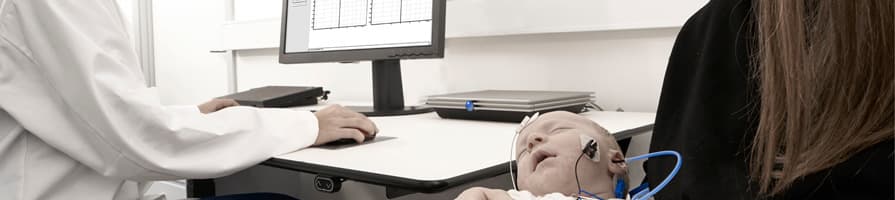
This course provides an overview of the basics of performing the auditory steady state response (ASSR) test. Access the ASSR course here.
This video provides a real-life demonstration of performing an auditory brainstem response (ABR) test in a newborn baby, via air conduction. Watch video here.
The CE-Chirp® family is a family of acoustic stimuli used in evoked potential testing, primarily auditory brainstem response (ABR) testing. Learn more.
Reducing electrode impedance is important for auditory brainstem response (ABR) testing. Learn what electrode impedance is and how to reduce it in this piece.
The normal hearing level (nHL) is the sound level of a short duration signal. It is often higher than the estimated behavioral hearing level (eHL). Learn more.