
How to perform the Active Head Rotation test

By Dr Michelle Petrak

What is the Active Head Rotation test?

The Active Head Rotation Test is useful when you have a bilateral caloric weakness, as it can provide information on the residual function of the vestibular system. If you have purchased the VORTEQ Diagnostics package, you will have license capabilities to perform Active Head Rotation (AHR) tests.
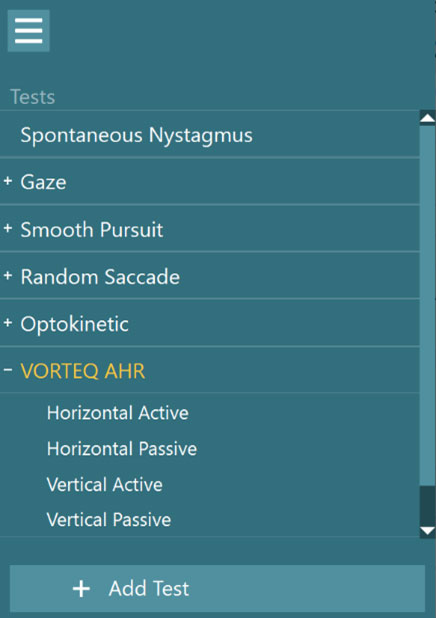
List of tests, including spontaneous nystagmus, gaze, smooth pursuit, random saccade, optokinetic, and VORTEQ active head rotation. For subtests for VORTEQ active head rotation are visible, including horizontal active, horizontal passive, vertical active, and vertical passive.

Figure 1 - License for VE525 and VORTEQ diagnostic bundle

Performing the test

To begin testing, select the first VORTEQ AHR subtest which is Horizontal Active. For active tests, the patient will be instructed to move their head to the beat of the metronome while fixating the target. In the default protocol, the target is a black dot on a white screen.

If you have not already calibrated in a previous test, you would need to calibrate before starting the test. If the eyes were already calibrated in a previous test, you are ready to begin and can hit start to begin the first subtest. Make sure the VORTEQ IMU is attached to the goggle and turned on. You will see a message telling you when the sensor is active, and you can begin testing.
Figure 2 - Message showing you the VORTEQ IMU is turned on and you are ready to start testing

During the test, you will see the head movement shown in yellow, the eyes in red and blue, and the gain and phase measurements.

There will be a short practice mode to let your patient get used to the head movements at the speed of the metronome.
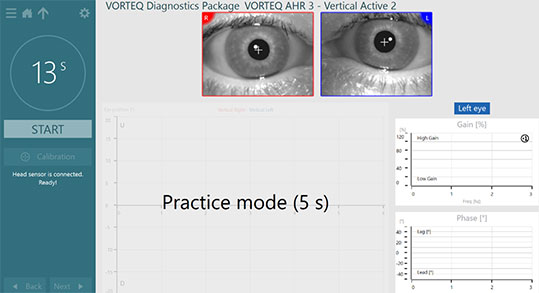
Vertical active subtest screen for VORTEQ active head rotation. Empty gain and phase graphs, and a greyed out eye position graph with the words 'Practice mode (5 s)'.

Figure 3 - Practice mode for Active Head Rotation testing
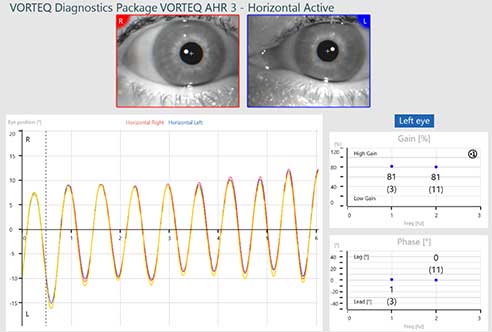
Horizontal active subtest screen for VORTEQ active head rotation. 81% gain at 1 and 2 hz. 1 degree phase lag at 1 hz. 0 degree phase at 2 hz. Smooth sinusoids for eye position that follow the target position nicely.

Figure 4 - Horizontal Active completed test

Next, you can perform the test passively (where you move the patient's head for them) or you can move on to the vertical subtests. The vertical subtests are performed with the patient following the metronome while moving their head up and down while fixating the target on the TV. Again, at the end of the test you will see a summary of the data.
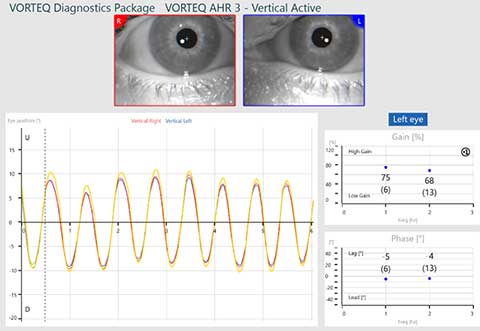
Vertical active subtest screen for VORTEQ active head rotation. 75% gain at 1 hz and 68% gain at 2 hz. 5 degree phase lead at 1 hz. 4 degree phase lead at 2 hz. Smooth sinusoids for eye position that fall a bit short of the target position.

Figure 5 - Vertical Active completed test

Results

When you have completed all the subtests, you will see a summary plot. You can use the arrows to toggle through multiple pages. The results plotted are similar to the data that is shown in rotation chair testing. You will have a plot for Gain, Phase and Symmetry.
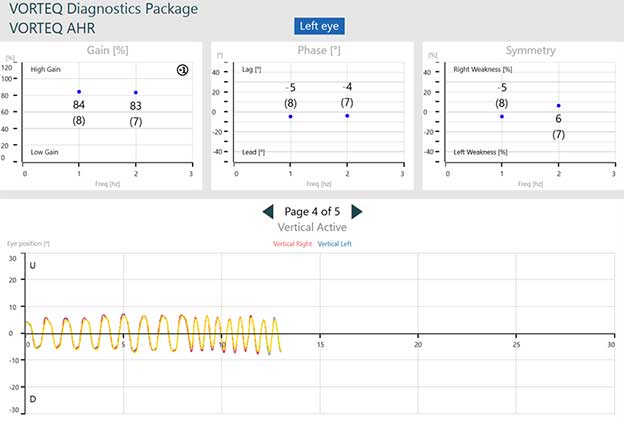
Summary plots for gain, phase, symmetry, and eye position. 84% gain at 1 hz and 83% gain at 2 hz. 5 degree phase lead at 1 hz and 4 degree phase lead at 2 hz. 5% left weakness at 1 hz and 6% right weakness at 2 hz. Eye position tracings follow the target position tracing quite closely.

Figure 6 - Summary plots

A perfectly normal gain would be 100% and we expect symmetrical responses.

For further assistance, if needed, please refer to the Instructions for use and Additional Information manuals.

Presenter
Dr Michelle Petrak

Dr Michelle Petrak

Dr. Michelle Petrak is the Director of Clinical Audiology for Interacoustics and is a licensed, practicing audiologist in the Chicago area. Dr. Petrak received her Doctorates in Electrophysiology and Biomolecular Electronics from Wayne State University in 1994 and her Masters in Audiology in 1989. Her special areas of expertise include vestibular and balance testing (VNG), electrophysiological techniques (ABR/ASSR/VEMP/ECoG) and pediatric audiology. Dr. Petrak is involved with product development, clinical evaluation testing, publishing, teaching and training on VNG and EP topics. In addition to being employed with Interacoustics, she is also a licensed and practicing audiologist at Northwest Speech and Hearing in Arlington Heights, IL. She continues to lecture extensively, nationally and internationally, and to publish articles in hearing industry journals.
Available Training

How to perform the Advanced Dix-Hallpike test

In this guide, you will learn how to perform the Advanced Dix-Hallpike using the VisualEyesTM videonystagmography (VNG) system.

Dr Michelle Petrak2026-10-02

How to perform the Brandt-Daroff Exercise

Click here to learn how to perform the Brandt-Daroff Exercise.

Interacoustics2026-10-02

How to perform calibration procedures

In this guide, you will learn how to calibrate the VisualEyesTM videonystagmography (VNG) system.

Dr Michelle Petrak2026-10-02

How to perform the Caloric test

Learn how to perform the caloric test with videonystagmography (VNG) equipment.

Interacoustics2026-10-02

How to perform Cervical Gaze testing

Two additional gaze positions are now available in VisualEyesTM 525 as an option to include in your test battery: Center Body Left and Right. Learn more.

Dr Liz Fuemmeler2026-10-02

How to perform the Dix-Hallpike test

Learn how to perform the Dix-Hallpike test, including precautions, patient instructions, the step-by-step test procedure, results interpretation, and more.

Interacoustics2026-10-02

How to perform the Dynamic Visual Acuity (DVA) test

Learn how to perform the dynamic visual acuity (DVA) test in the VisualEyesTM software.

Dr Michelle Petrak2026-10-02

How to perform the Epley Maneuver

Learn how to perform the Epley Maneuver for treatment of posterior canal BPPV. Includes a step-by-step procedure with images and helpful hints. Read more.

Interacoustics2026-10-02

How to use VisualEyesTM EyeSeeCam

In this guide, you will learn how to use the EyeSeeCam vHIT software within the VisualEyesTM videonystagmography (VNG) system.

Dr Michelle Petrak2026-10-02

How to perform the Functional Vision Head Impulse Test (fvHITTM)

The Functional Vision Head Impulse Test (fvHITTM) provides functional information on how clearly the patient sees in response to quick head impulses. Read more.

Dr Liz Fuemmeler2026-10-02

How to perform the Gaze test

Learn how to perform the gaze test with videonystagmography (VNG) equipment.

Interacoustics2026-10-02

How to perform the Gaze Stabilization Test (GST)

Learn how to perform the Gaze Stabilization Test (GST) in the VisualEyesTM software. Click here to read more.

Dr Michelle Petrak2026-10-02

How to perform the Gufoni Maneuver

Learn how to perform the Gufoni Maneuver in this short guide. Includes a step-by-step procedure with images and helpful hints. Read more.

Interacoustics2026-10-02

How to set up and troubleshoot monitors for oculomotor and optotype tests

In this quick guide, you will learn how to set up and troubleshoot monitors for oculomotor and optotype tests in the VisualEyesTM software. Read more.

Dr Liz Fuemmeler2026-10-02

How to use keyboard shortcuts in VisualEyesTM

VisualEyesTM has several software functions that are available through a computer keyboard. These allow for the user to access quick buttons for easy navigation.

Dr Liz Fuemmeler2026-10-02

How to perform the Lateral Head Roll test

Learn how to perform the lateral head roll (LHR) test with the VisualEyesTM software.

Dr Michelle Petrak2026-10-02