
How to perform the Sinusoidal Harmonic Acceleration (SHA) test
What is the Sinusoidal Harmonic Acceleration (SHA) test?
The Sinusoidal Harmonic Acceleration (SHA) test measures the patient's Vestibulo-Ocular Reflex (VOR) by rotating the patient in a pendular pattern at various frequencies ranging from 0.01 Hz up to 0.64 Hz with vision denied. This test is considered the "gold standard" test for identifying a bilateral vestibular weakness. The SHA test can also be used to aid in the diagnosis of a unilateral vestibular loss and can be used to monitor vestibular compensation over time.
Patient instructions
"You will feel yourself rocking back and forth slowly in the chair. During the rotation, I will be asking you several questions to keep you alert. Please keep your eyes open during the entire test."
Normal SHA test results
A patient with normal SHA results will produce an eye position tracing that shows nystagmus changing from right-beating to left-beating as the chair changes directions. The plotted points in the eye velocity graph will appear to be approximately 180 degrees out of phase from the yellow chair signal trace. The resulting data points for each frequency tested will appear in the Gain, Phase, and Symmetry graphs on the summary screen.
These data points will appear in the white region when results are normal and will appear in the shaded region when they are outside of threshold limits. The larger data point denotes which test frequency eye position and eye velocity graphs are currently being displayed. The first half- cycle of each frequency tested is excluded from analysis for improved reliability.
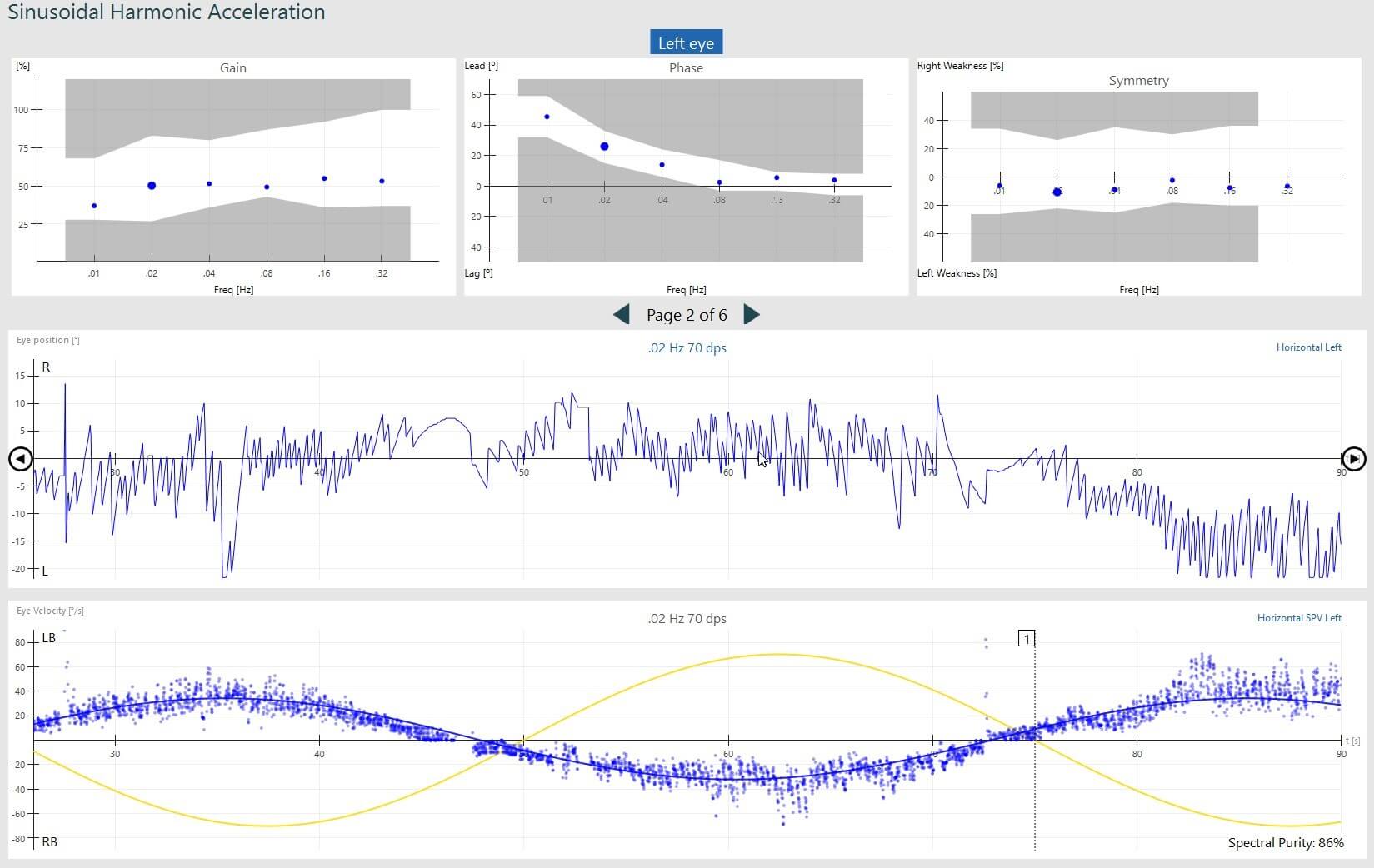
SHA test showing normal responses from 0.01 to 0.32 Hz
Abnormal SHA test results
Abnormal SHA test results may present in several different ways.
1. Reduced VOR gain
Reduced VOR gain over a range of test frequencies may indicate that there is a bilaterally weak peripheral vestibular system, provided that technical issues have been accounted for. Please note that phase and symmetry values are of little diagnostic value in the case significantly reduced gains.
2. Phase lead
A higher than expected phase lead may provide evidence of a disorder affecting the peripheral vestibular system and/or vestibular nerve, or central pathology in rare cases. A decreased phase lead is more often related to central pathology but may also be observed in the presence of vestibular migraines or motion intolerance.
3. Asymmetric response
An asymmetric response is like a directional preponderance in caloric testing. An asymmetric SHA response indicates that there is a difference between maximum left-beating and maximum right-beating eye velocity during sinusoidal rotation and provides evidence of a potential unilateral vestibular pathology.
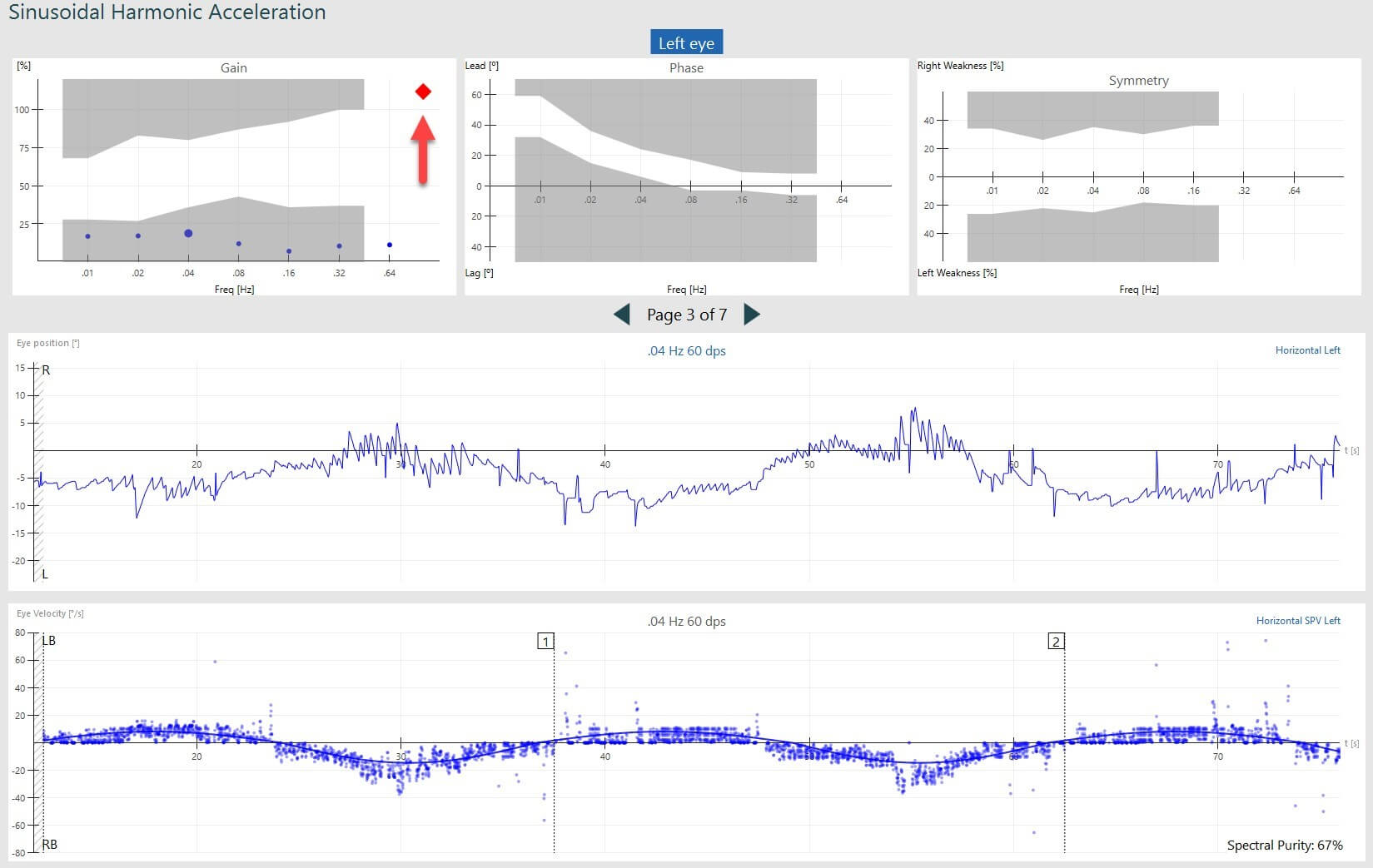
SHA test showing significantly reduced VOR gain across all frequencies
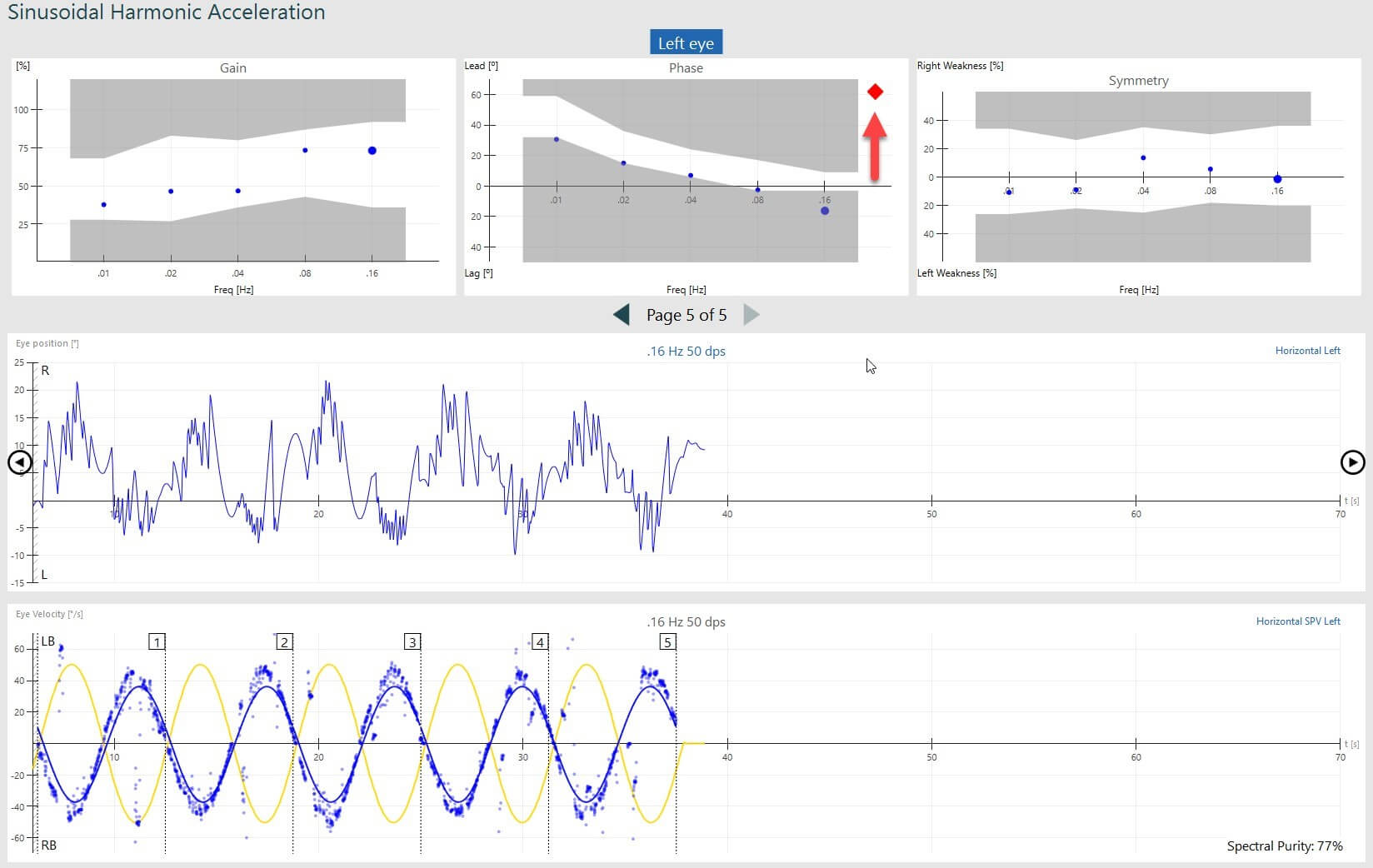
SHA test showing borderline reduced phase across all frequencies
Spectral purity
In addition to Gain, Phase, and Symmetry, an additional parameter, Spectral Purity, is available in SHA testing. A high percentage of Spectral Purity indicates a more reliable result. The closer the data fits a sine wave, the higher the spectral purity. When spectral purity falls below 60%, it provides evidence that the response may not be of high quality and the clinician should consider retesting that frequency.
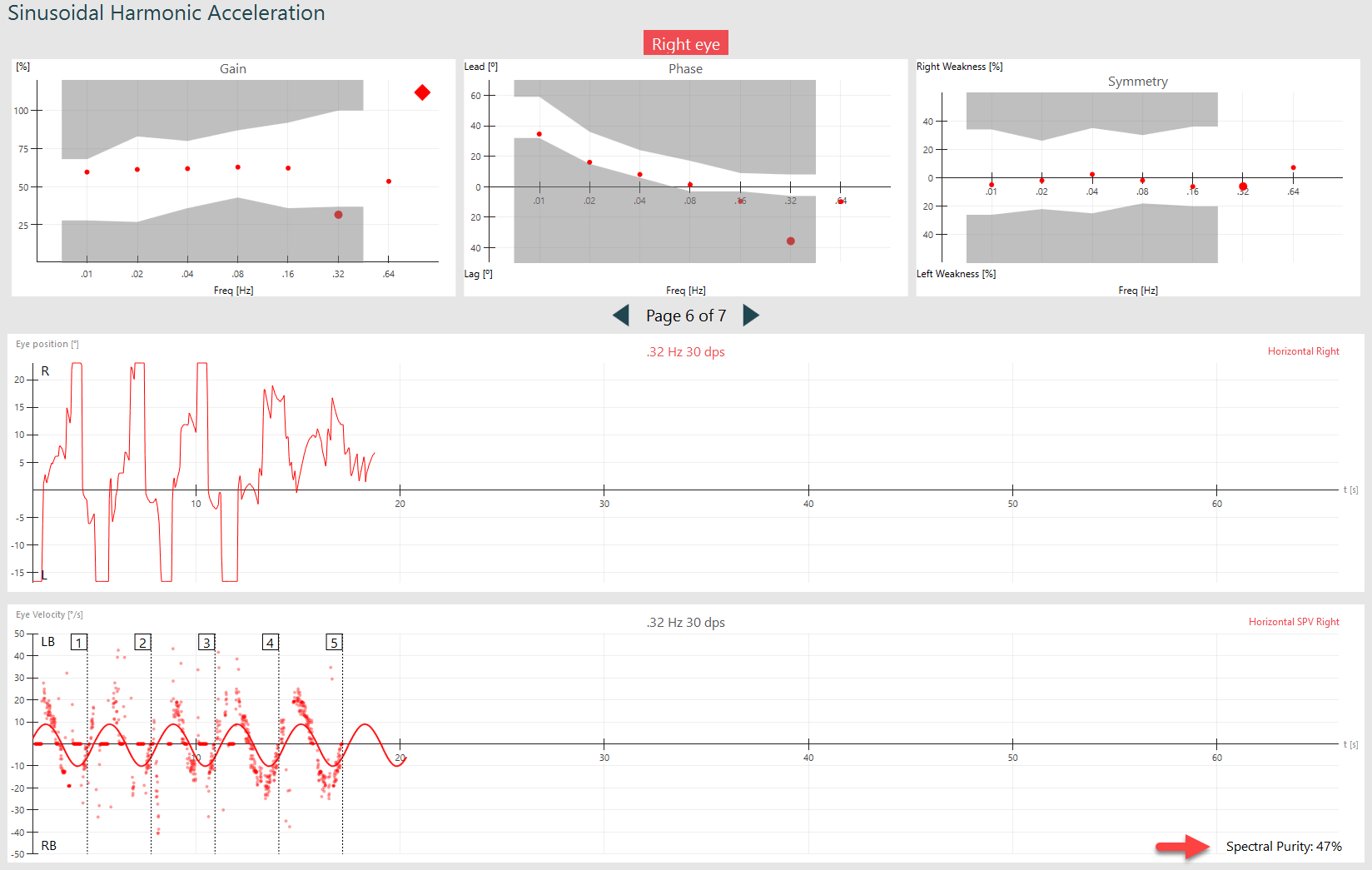
SHA test showing poor spectral purity at 0.32 Hz, resulting in erroneous data at that frequency
Conclusion
SHA testing can be used to identify a bilateral weakness or aid in diagnosis of a unilateral weakness and allows the clinician to see how the patient's VOR is performing across multiple frequencies over time. It is a very sensitive test but is not necessarily a specific test. Therefore, to get a more comprehensive look at the vestibular system (lateral semicircular canals), a clinician may choose to perform video head impulse testing (vHIT) or caloric testing along with rotational chair testing.
References
Jacobson, GP, and Shepard, NT. Balance Functional Assessment and Management, 2nd Ed. San Diego; Plural Publishing, 2015.
Disclaimer
*NOTE: This is intended only as a guide, official diagnosis should be deferred to the patient's physician.
Presenter