
How to perform the Smooth Pursuit test
What are smooth pursuit eye movements?
Smooth pursuit eye movements, also known as smooth pursuit, enable the eyes to effortlessly track and follow moving objects within the visual field. In cases where the smooth pursuit system is impaired due to a central lesion, the eyes may lag behind the moving target, necessitating catch-up saccades to reestablish fixation on the target. Consequently, this can give rise to various sensations of dizziness or related symptoms, which patients may commonly report.
What is the smooth pursuit test?
The smooth pursuit test measures the patient's ability to accurately track a visual target in a smooth controlled manner. Smooth pursuit tracking assesses the patient's central vestibular system. Although several methods of smooth pursuit tracking have been researched, it is the controlled-velocity method that has been proven to be the most clinically useful; therefore, it is the controlled-velocity method that is shown in this guide.
Patient instructions
"You will see a green dot on the screen. The dot will move from one side of the screen to the other in a smooth, predictable motion. Your task is to follow the dot with your eyes while keeping your eyes precisely on the dot. Try not to move your head and try not to get "ahead of" or "behind" the target."
Normal smooth pursuit results
A patient with the ability to perform smooth pursuit tracking normally will produce a response in which the stimulus target and the eye tracings are virtually identical. The stimulus is represented by the yellow target line and the right and left eyes are represented by red and blue tracings, respectively. The responses for each cycle of the pursuit are represented on the graph by red dots for the right eye and blue dots for the left eye. Responses that are within threshold limits will fall in the white region and responses outside the threshold limits will fall in the grey shaded region.
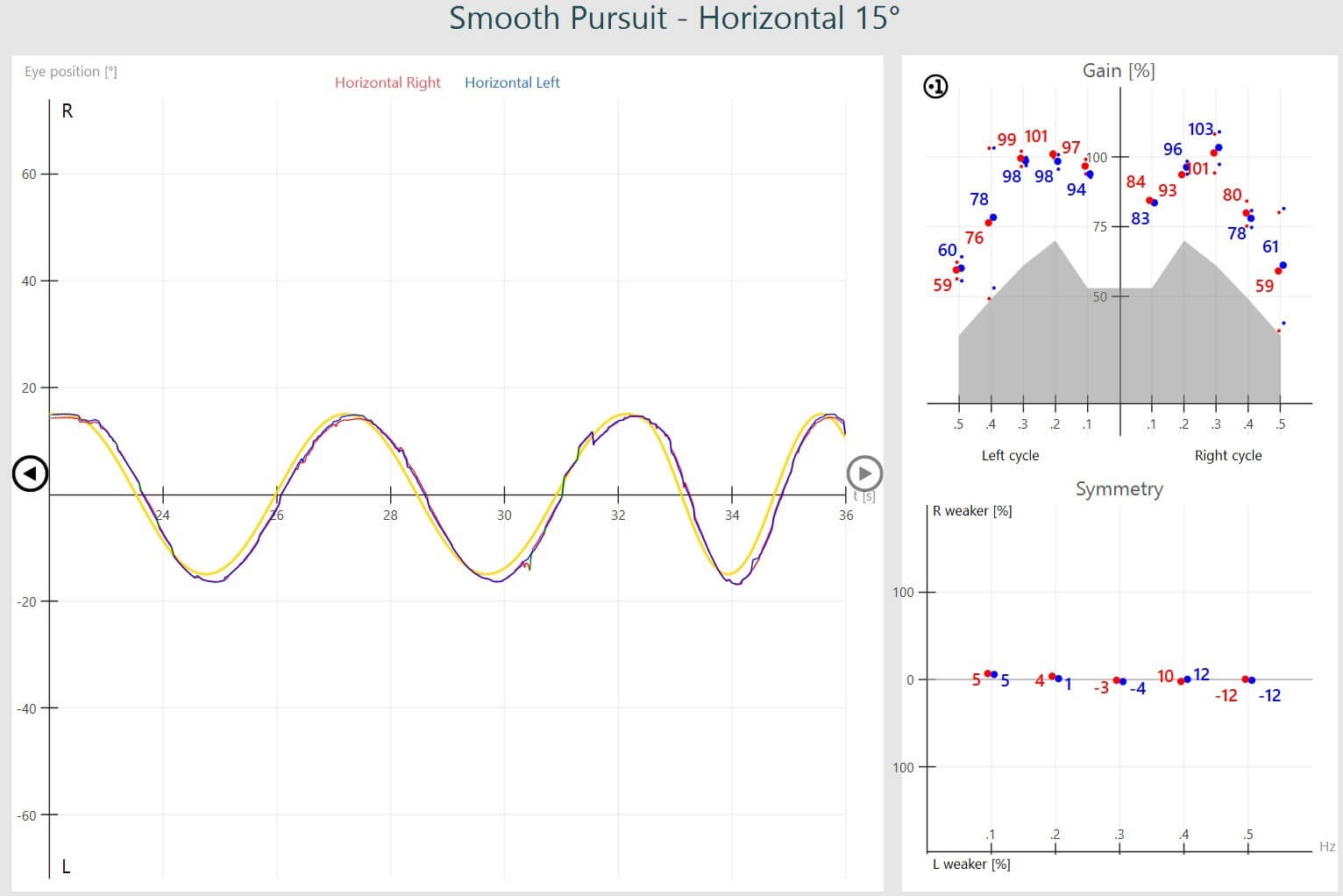
Smooth pursuit test showing a normal response to an increasing-frequency (Hz) target over time.
Abnormal smooth pursuit results
It is important to know that the smooth pursuit tracking test is the most sensitive of the ocular tests to age-effect (i.e. older patients are the more likely to produce errors during the performance of the task). Also, unlike saccades, where the movement of the eye is something that is unconsciously done many times throughout the day, the smooth pursuit tracking task is something that may need to be "taught" to the patient. Therefore, it is necessary that the patient be allowed to perform two or three "trials" of the task to look for the patient's best performance (unless the patient performs the task accurately on the first trial).
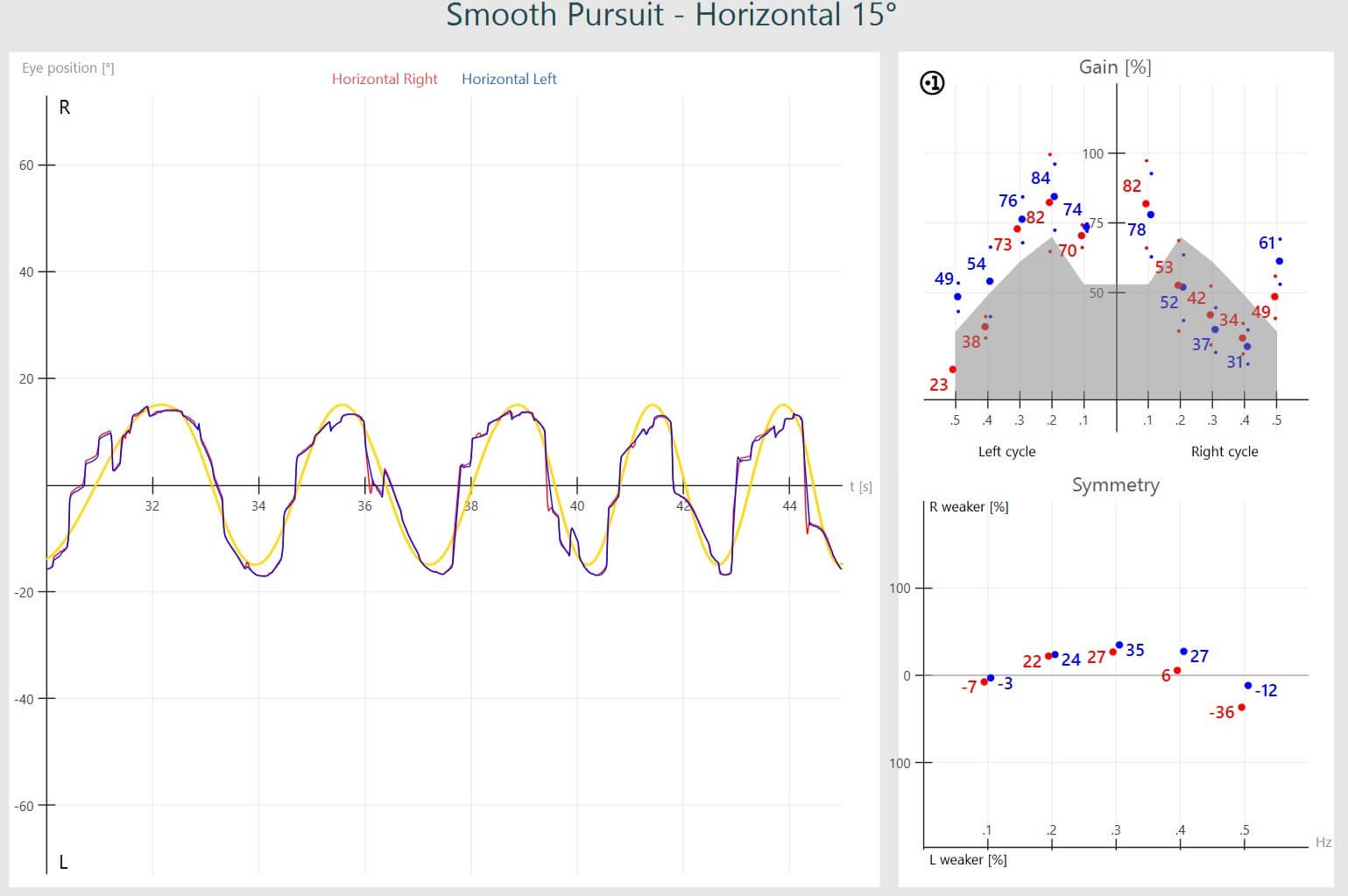
Abnormal smooth pursuit test showing reduced gains and saccadic intrusions in the higher frequencies with the patient having more difficulty when the target is moving towards the right.
*NOTE: It is possible that the patient can accurately track the target in one direction, but not in the other direction. In most cases, the abnormality will present itself toward the side that has the lesion.
Conclusion
Smooth pursuit tracking is an ocular test used to determine whether there is central pathology that is precluding accurate tracking of moving targets by the eyes. Smooth pursuit tracking is susceptible to an age-effect and may require that the examiner acclimate the patient to the task prior to recording. For a complete discussion of differential diagnosis using smooth pursuit tracking, refer to:
Jacobson, GP, and Shepard, NT. Balance Functional Assessment and Management, 2nd Ed. San Diego; Plural Publishing, 2015
*NOTE: This is intended only as a guide, official diagnosis should be deferred to the patient's physician.
Presenter