
How to perform the Velocity Step test
What is the Velocity Step Test?
The Velocity Step Test measures the patient's Vestibulo-Ocular Reflex (VOR) by rotating the patient at an acceleration impulse of 100°/s2 to a fixed chair velocity with vision denied. The time constants, response gain, and time constant asymmetry are then measured. By measuring the vestibular system time constant, both the peripheral vestibular response to the rotational stimulus, as well as the central velocity storage mechanism can be evaluated, making this a useful test for aiding in the diagnosis of a variety of vestibular disorders.
Patient instructions
"You will feel yourself rotating in one direction for several seconds. During the rotation, I will be asking you several questions to keep you alert. As you are rotating, you may feel as though you are slowing down. When the chair stops, you will feel as though you are rotating in the opposite direction. There will be four segments and each segment will take approximately 1 minute. Please keep your eyes open during the entire test."
Normal Velocity Step Test results
A patient with normal Step Test results will produce a tracing that demonstrates robust nystagmus at the beginning of each per-rotary and post-rotary step. The nystagmus will then decay over time as the patient perceives that the chair is slowing down or even stopping. The nystagmus points will be marked with triangles in the eye position (°) graph, and the corresponding eye velocity (°/sec) graph displays data points representing each detected beat. The vertical dashed lines in the eye velocity graph represent the start and end points for the time constant measurement and the curve fit is displayed in yellow. The data points for each per-rotary and post-rotary step at each velocity tested will appear as triangles in the gain (%), time constant (s), and time constant symmetry (%) graphs above the tracings on the summary screen. These data points will appear in the white region when results are normal and will appear in the shaded region when results are outside of threshold limits.
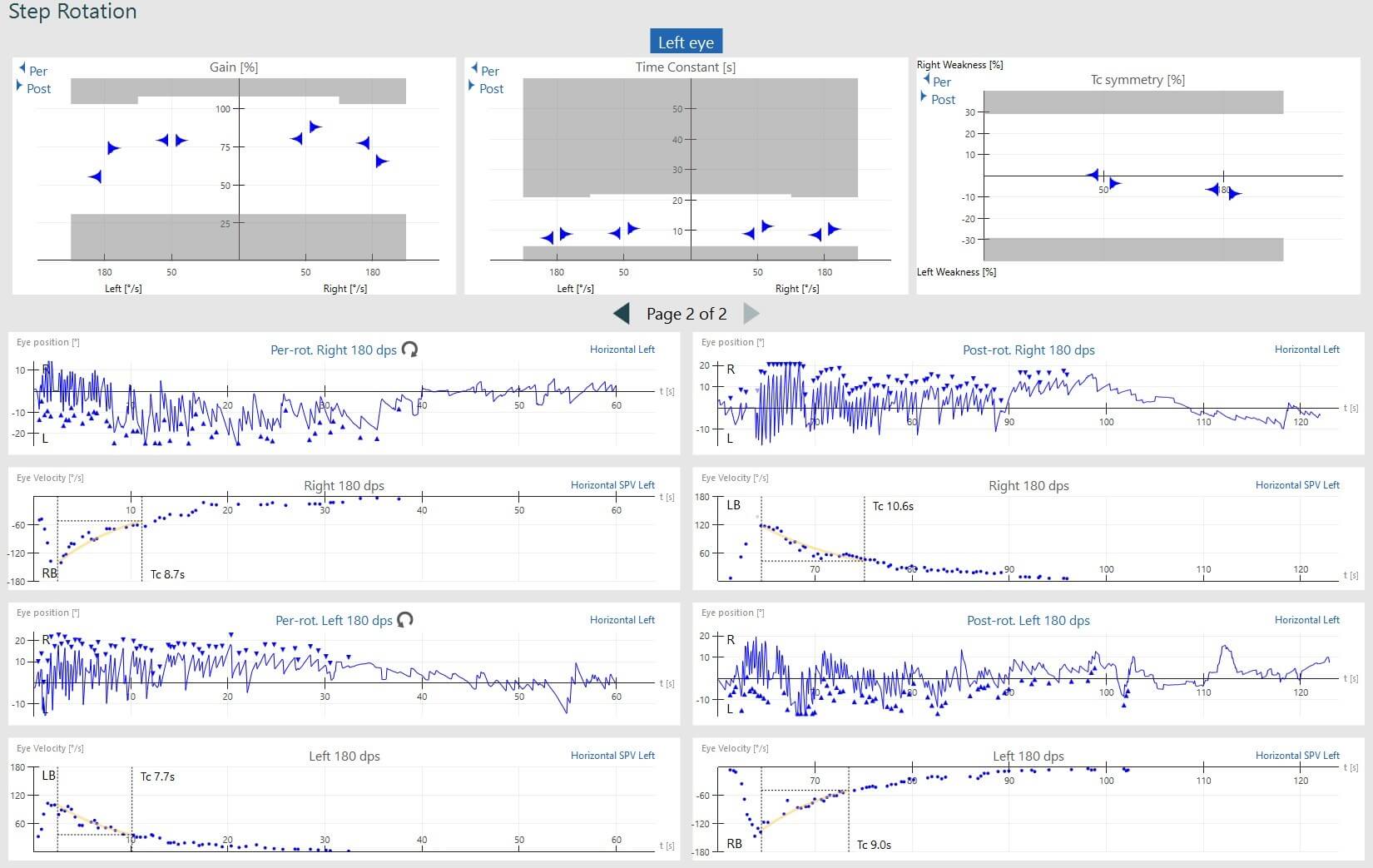
Step test showing a normal response.
Abnormal Velocity Step Test results
An abnormal Step test may present in many ways. The most diagnostically significant parameter in Step test is the time constant, which is the amount of time it takes for the slow phase velocity of the nystagmus to decrease by 37% of its peak velocity. Reduced time constants may be associated with unilateral or bilateral vestibular pathology, or central vestibular involvement. It has been suggested that abnormally long-time constants may be associated with motion intolerance or central vestibular pathology.
Abnormalities in time constant symmetry can be useful in helping to determine the weaker side in unilateral vestibular pathology, particularly with the higher velocity step test.
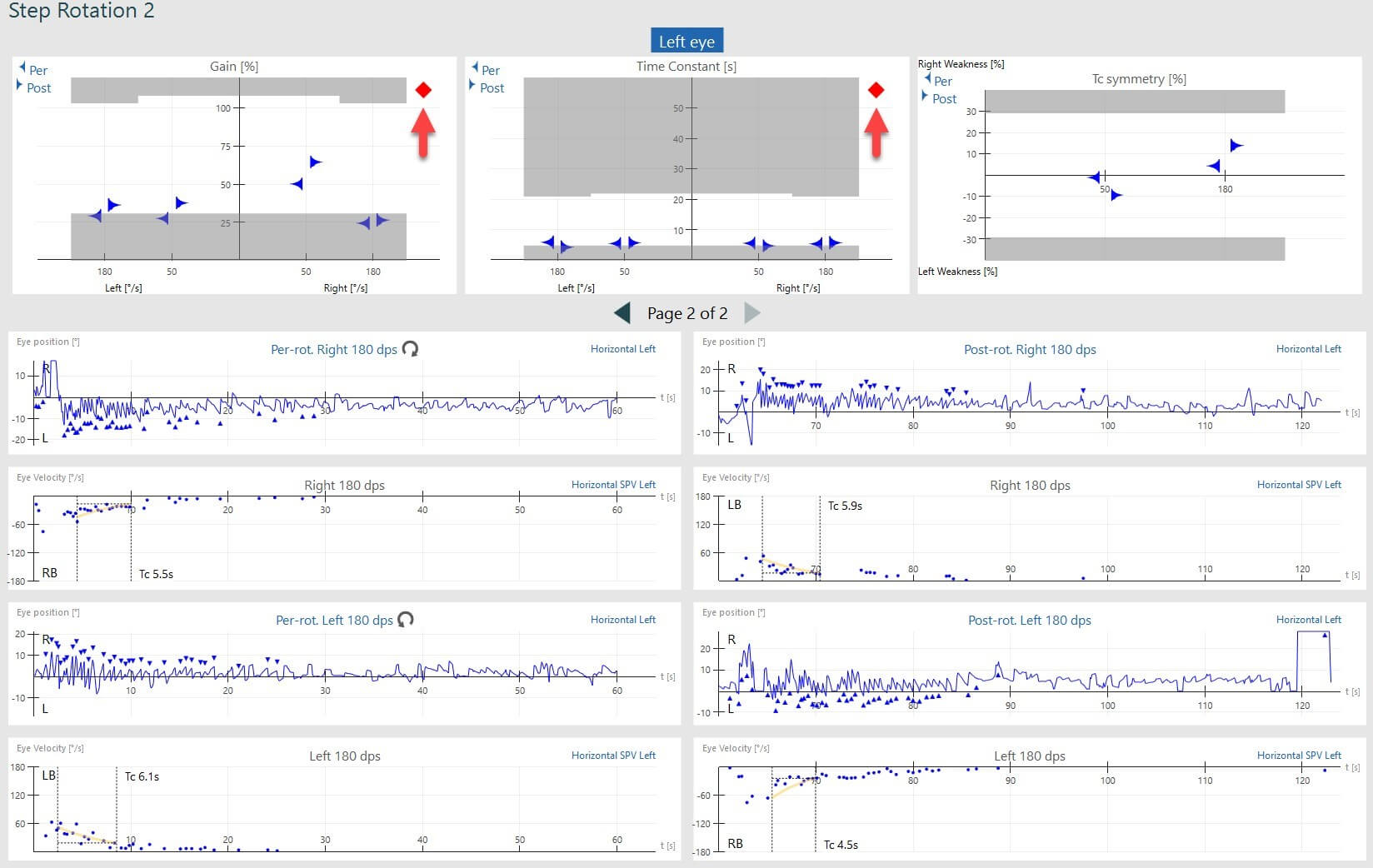
Step test showing reduced gain and time constants.
Conclusion
Step testing, along with SHA and VOR Suppression tests, can be useful in identifying a unilateral or bilateral vestibular pathology, and can help differentiate between peripheral and central involvement. To obtain a more compressive evaluation of the vestibular system (lateral semicircular canals), a clinician may choose to perform video head impulse testing (vHIT) or caloric testing, along with rotational chair testing.
References
Jacobson, GP, and Shepard, NT. Balance Functional Assessment and Management, 2nd Ed. San Diego; Plural Publishing, 2015.
Disclaimer
*NOTE: This is intended only as a guide, official diagnosis should be deferred to the patient's physician.
Presenter