
How to Identify a Loose Probe Fit

By Interacoustics

About the author

The information presented here is based on clinical examples as well as modeled patterns. Text and accompanying. Absorbance sketch is authored by Navid Shahnaz, PhD, Aud, Associate Professor of Audiology in the School of Audiology & Speech Sciences at the University of British Columbia (UBC).


Caveats

Absorbance measures under more or less blocked conditions will vary. The displayed Absorbance pattern is a sketched example only.


Absorbance characteristics to look for

The condition obviously has great variability due to the many ways the probe can be loosely fit. In general, the Absorbance will be at an unusually high level at frequencies below 2 kHz, and the pattern might be jerky.
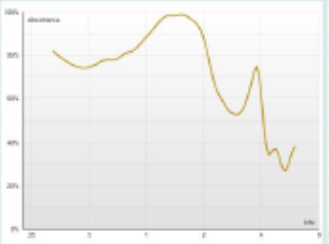
 

Sketched example of absorbance pattern
Sketched example


Consequences of probe fit

All Absorbance measures need to have a good probe fit to be reliable. Evaluating Absorbance as provided by the 3D Tympanometry test ensures that a reasonably air tight probe seal was accomplished, as the air pressure sweep would not have been performed otherwise. In addition to an air tight probe seal, a deeper rather than a shallower probe insertion ensures the most accurate Absorbance measures. Shallow insertions tend to provide more elevated Absorbance readings at lower frequencies. This is somewhat similar to normal Tympanometry measures that are also influenced by probe fit and probe insertion depth.


Suggested reading

Effects of Middle-Ear Disorders on Power Reflectance Measured in Cadaveric Ear Canals, Voss, Susan E., Merchant, Gabrielle R.,Horton, Nicholas J., Ear & Hearing. 33(2):195-208, March/April 2012.

Acoustic Immittance Measures, Basic and Advanced Practice, 2013, Lisa Hunter, Phd, FAAA, Navid Shahnaz, PhD, Aud. (C), Plural Publishing. ISBN10: 1-59756-437-0, ISBN13: 978-1-59756-437-3.

Presenter

Interacoustics

Available Training

Creating an ABRIS Test Protocol

Learn how to use the Titan's automated ABR protocol.

Interacoustics2026-10-02

Acoustic Reflex Testing

Learn how to perform acoustic reflex testing with the Titan tympanometer.

Interacoustics2026-10-02

Best Practices for OAE Testing

Learn how to get the most out of your Titan for OAE testing.

Interacoustics2026-10-02

How to Identify a Blocked Probe Fit

Learn how to identify a blocked probe fit with the Titan tympanometer.

Interacoustics2026-10-02

How to Change the Probe Tip

Learn how to change the Titan's probe tip.

Interacoustics2026-10-02

How to Clean the Probe Tip

Learn how to clean the Titan's probe tip.

Interacoustics2026-10-02

Creating a DPOAE Pass/Refer Test Protocol

Learn how to create a DPOAE pass/refer test protocol with the Titan.

Interacoustics2026-10-02

Creating a TEOAE Pass/Refer Test Protocol

Learn how to create a TEOAE pass/refer test protocol with the Titan.

Interacoustics2026-10-02

Daily System Check

Learn how to perform a daily system check of your Titan.

Interacoustics2026-10-02

Electrode Tips & Tricks

Learn how to get the most out of your electrodes for testing with the Titan.

Interacoustics2026-10-02

How to Identify Fluid in the Middle Ear

Learn how to identify fluid in the middle ear with the Titan tympanometer.

Interacoustics2026-10-02

How to clean the Titan probe tube

In this video, you will learn how to clean the Titan's probe tube.

Interacoustics2026-10-02

How to print without a database

Click here to learn about the three options you have for printing without a database with the Titan handheld tympanometer.

Interacoustics2026-10-02

Mastoid Electrode Montage

Learn how to prepare the patient's skin and apply mastoid electrodes for automated ABR testing with the Titan.

Interacoustics2026-10-02

How to Measure eSRT

Learn how to measure electrically evoked stapedial reflex thresholds (eSRTs) with the Titan.

Interacoustics2026-10-02

Nape Electrode Montage

Learn how to perform nape electrode montage.

Interacoustics2026-10-02