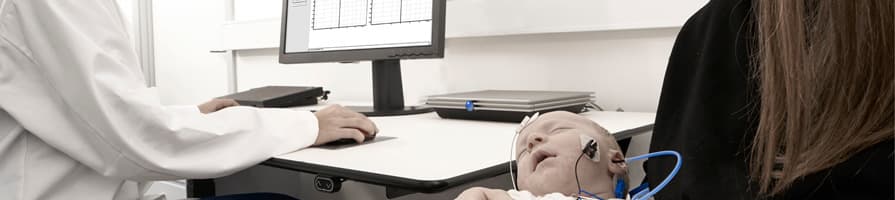
How to prepare the patient for ABR and ASSR testing

By Interacoustics

Transcript

Before you start testing, instruct the patient to turn off all their electronic devices in order to minimize noise.

Now, look in your patient's ear to ensure no excess cerumen is present.

Clean the patient's skin on the high and low forehead and behind each ear on the mastoid.

Wipe off any excess abrasive gel and place your four electrodes.

If doing bone conduction, you can place the electrodes lower on the mastoid.

Connect the electrode cables.

You can twist the cables to help the common mode rejection and improve results.

Now, test the impedance.

Impedances below five kiloohms are acceptable.

It is important that there is no more than two kiloohms of imbalance in impedances between electrodes.

Insert transducers and start testing.

During the test, the patient should relax with their eyes closed and even go to sleep, if possible, as this will improve results.

Presenter
Interacoustics

Available Training

ALR / Cortical Evoked Response Audiometry

Learn how to measure auditory late responses (ALRs) with cortical evoked response audiometry (CERA) using the Eclipse evoked potentials system. Read more.

Rasmus Skipper, MSc Audiology2026-10-02

ASSR Hearing Test

Learn how to perform the auditory steady-state response (ASSR) test with the Eclipse device.

Rasmus Skipper, MSc Audiology2026-10-02

Basic ABR Testing

Learn how to perform auditory brainstem response (ABR) testing with the Eclipse device.

Rasmus Skipper, MSc Audiology2026-10-02

Electrocochleography

Learn how to perform electrocochleography with the Eclipse evoked potentials device, including electrode placement, labeling waveforms, and much more.

Interacoustics2026-10-02

Bayesian Weighting

Learn what Bayesian weighting is and when and why you should use it (and when it may be less relevant to use it). Click here to learn more.

Interacoustics2026-10-02

Cochlear Microphonics

Learn how to measure cochlear microphonics with the Eclipse device.

Rasmus Skipper, MSc Audiology2026-10-02

cVEMP Testing

Learn how to measure cervical vestibular-evoked myogenic potentials (cVEMPs) with the Eclipse device.

Interacoustics2026-10-02

Daily System Check

Learn how to perform a daily system check on the Interacoustics Eclipse.

Interacoustics2026-10-02

Electrical Auditory Brainstem Response (eABR)

Learn how to measure the electrical auditory brainstem response (eABR) with the Eclipse device.

Rasmus Skipper, MSc Audiology2026-10-02

Eclipse Onboarding Resource

This resource is designed to give you a thorough understanding of the Eclipse, so you can get up and running quickly and make the best possible measurements.

Leigh Martin2026-10-02

Electrode Tips & Tricks

Discover electrode tips and tricks while using your Interacoustics Eclipse.

Interacoustics2026-10-02

Fmp and Residual Noise

Learn about the Fmp and Residual Noise metrics for auditory brainstem response (ABR) testing and why they are so important. Click here to learn more.

Rasmus Skipper, MSc Audiology2026-10-02

How to add a new patient in OtoAccess ® Database

Learn how to add a new patient in OtoAccess Database before testing with your Interacoustics Eclipse.

Interacoustics2026-10-02

How to customize your ABR protocol

Learn how to customize your auditory brainstem response (ABR) protocol with the Interacoustics Eclipse.

Interacoustics2026-10-02

How to Improve Evoked Potential Recordings

Learn how to improve your evoked potential recordings, including skin preparation and tips to reduce noise.

Interacoustics2026-10-02

How to make changes to a saved session

Learn how to make changes to a saved session with the Interacoustics Eclipse.

Interacoustics2026-10-02