How to perform the Epley Maneuver

By Interacoustics

Epley Maneuver for posterior canal BPPV
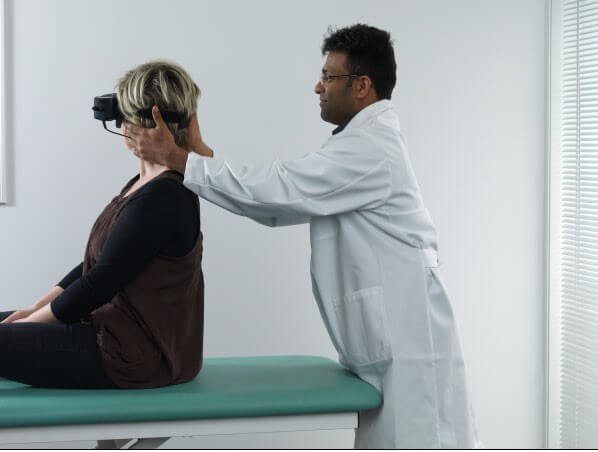
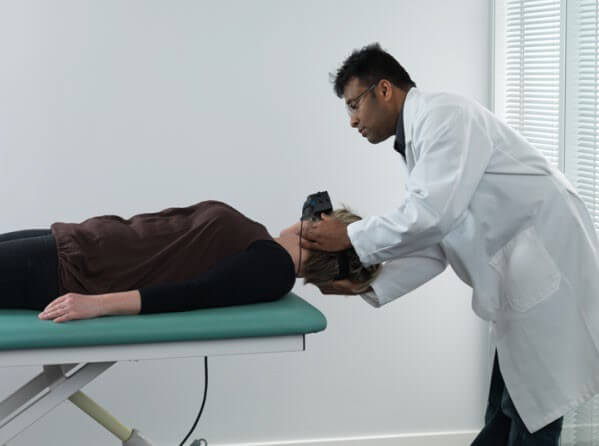
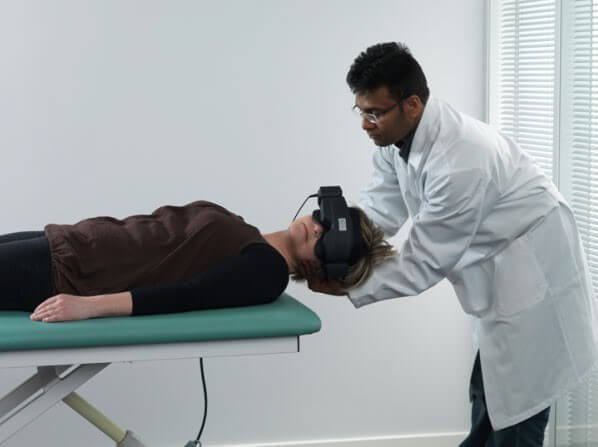
Female patient sitting on examination table with back toward a male clinician. The clinician is turning the patient's head 45 degrees toward the right. Female patient lying on her back on examination table, with head hanging over the edge of the table. Male clinician is turning the patient's head toward the right.
Begin with the patient's head turned 45 degrees toward the affected side. Bring to a supine position with the head turned toward the affected side and hanging 20°.


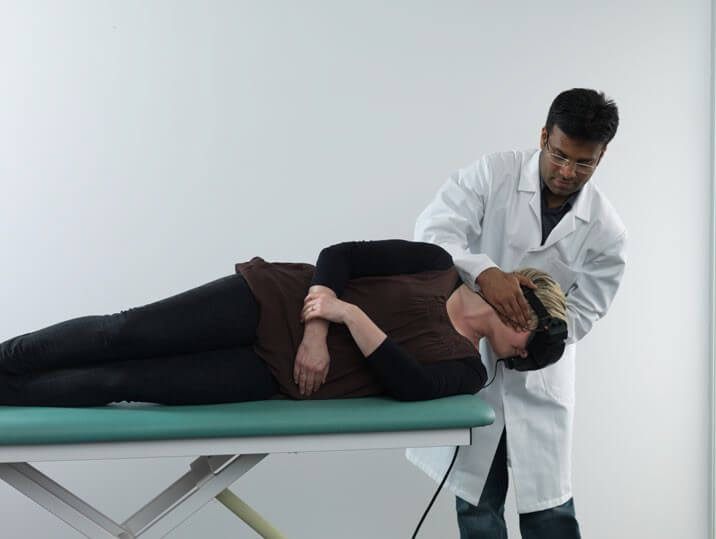
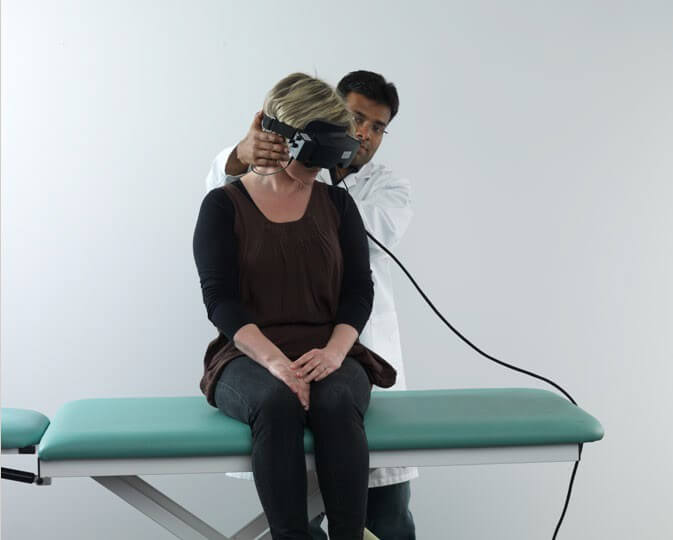
Female patient lying on her back on examination table, with head hanging over the edge of the table. Male clinician is turning the patient's head toward the left. Female patient lying on her left side on examination table, with head hanging over the edge of the table. Male clinician is turning the patient's head toward the left, so it is pointing toward the floor. Female patient sitting on examination table with back toward a male clinician, and legs dangling off the edge of the table. The clinician is turning the patient's head 45 degrees toward a downward, left position.

Rotate the patient's head 90 degrees toward the unaffected side.

Guide the patient to the side lying position with their nose pointing to the ground.

While keeping the head in 45°, tucked position, return the patient to a seated position.


Helpful hints


1. Consider using VNG

It is most helpful to utilize Frenzel lenses or VNG while performing CRP. This reduces the ability of the patient to fixate during the procedure in an attempt to reduce the nystagmus response. This will also allow the examiner to see even very slight torsional nystagmus.


2. Past injuries

Before performing any positioning maneuver, it is important to ascertain whether the patient has current or past injuries of the neck or spine.


3. Neurological symptoms

If neurological symptoms occur during the execution of positioning maneuvers, discontinue the procedure immediately and refer for a neurological evaluation. These symptoms might include, blurred vision, numbness, weakness of the arms or legs or confusion.


4. Efficacy

Efficacy of the procedure is increased to more than 90% if CRP is performed twice in rapid succession.


5. Postural support

It is not unusual for the patient to lose postural control at the completion of the procedure due to the otoconia briskly falling within the cupula. It is vital that the examiner is in a stance that will provide postural support to the patient.


6. Watch for changes in nystagmus

It is important to watch for changes in the nystagmus upon completion of the procedure: a reversal of nystagmus indicates that the otoconia fell back into the canal; an upbeat nystagmus indicates that the otoconia fell back into the cupula.


Epley maneuver procedure

  1. Begin with the patient sitting length-wise on the examination table.
  2. Place the Frenzel/VNG goggles on the patient.
  3. Have the patient turn his head to a 45° angle toward the side that you are going to treat (the affected side).
  4. While maintaining the 45° head position, guide the patient in a continuous motion from sitting to lying with the head hanging off the table at approximately 20o. It is imperative to provide cervical support during this portion of the procedure.
  5. Hold this position for 30-60 seconds.
  6. Maintain the 20° head extension and rotate the patient's head 90° toward the unaffected side so that the patient's head is approximately 45° toward the unaffected side.
  7. Hold this position for 30-60 seconds.
  8. While still maintaining the 45° head position, guide the patient into a side-lying position on the shoulder of the unaffected side. The patient's nose should be pointed toward the floor.
  9. Hold this position for 30-60 seconds.
  10. Instruct the patient to tuck his chin and maintain the 45° head position.
  11. Guide the patient back into a sitting position while ensuring that the patient's head remains at the 45° angle and the chin remains tucked.


References

  • Epley J. The canalith repositioning procedure: for treatment of benign paroxysmal positional vertigo. Otolaryngol Head Neck Surg 1992;107:399-404
  • Honrubia V, Baloh RW, Harris MR, et al. Paroxysmal positional vertigo syndrome. Am J Otol. 1999;20:465-470
  • Sherman D, Massoud EA. Treatment outcomes of benign paroxysmal positional vertigo. J Otolaryngol 2001;30:295-299.

Presenter
Interacoustics

Available Training

How to perform the Active Head Rotation test

Learn how to perform the active head rotation (AHR) test in the VisualEyesTM software.

Dr Michelle Petrak2026-10-02

How to perform the Advanced Dix-Hallpike test

In this guide, you will learn how to perform the Advanced Dix-Hallpike using the VisualEyesTM videonystagmography (VNG) system.

Dr Michelle Petrak2026-10-02

How to perform the Brandt-Daroff Exercise

Click here to learn how to perform the Brandt-Daroff Exercise.

Interacoustics2026-10-02

How to perform calibration procedures

In this guide, you will learn how to calibrate the VisualEyesTM videonystagmography (VNG) system.

Dr Michelle Petrak2026-10-02

How to perform the Caloric test

Learn how to perform the caloric test with videonystagmography (VNG) equipment.

Interacoustics2026-10-02

How to perform Cervical Gaze testing

Two additional gaze positions are now available in VisualEyesTM 525 as an option to include in your test battery: Center Body Left and Right. Learn more.

Dr Liz Fuemmeler2026-10-02

How to perform the Dix-Hallpike test

Learn how to perform the Dix-Hallpike test, including precautions, patient instructions, the step-by-step test procedure, results interpretation, and more.

Interacoustics2026-10-02

How to perform the Dynamic Visual Acuity (DVA) test

Learn how to perform the dynamic visual acuity (DVA) test in the VisualEyesTM software.

Dr Michelle Petrak2026-10-02

How to use VisualEyesTM EyeSeeCam

In this guide, you will learn how to use the EyeSeeCam vHIT software within the VisualEyesTM videonystagmography (VNG) system.

Dr Michelle Petrak2026-10-02

How to perform the Functional Vision Head Impulse Test (fvHITTM)

The Functional Vision Head Impulse Test (fvHITTM) provides functional information on how clearly the patient sees in response to quick head impulses. Read more.

Dr Liz Fuemmeler2026-10-02

How to perform the Gaze test

Learn how to perform the gaze test with videonystagmography (VNG) equipment.

Interacoustics2026-10-02

How to perform the Gaze Stabilization Test (GST)

Learn how to perform the Gaze Stabilization Test (GST) in the VisualEyesTM software. Click here to read more.

Dr Michelle Petrak2026-10-02

How to perform the Gufoni Maneuver

Learn how to perform the Gufoni Maneuver in this short guide. Includes a step-by-step procedure with images and helpful hints. Read more.

Interacoustics2026-10-02

How to set up and troubleshoot monitors for oculomotor and optotype tests

In this quick guide, you will learn how to set up and troubleshoot monitors for oculomotor and optotype tests in the VisualEyesTM software. Read more.

Dr Liz Fuemmeler2026-10-02

How to use keyboard shortcuts in VisualEyesTM

VisualEyesTM has several software functions that are available through a computer keyboard. These allow for the user to access quick buttons for easy navigation.

Dr Liz Fuemmeler2026-10-02

How to perform the Lateral Head Roll test

Learn how to perform the lateral head roll (LHR) test with the VisualEyesTM software.

Dr Michelle Petrak2026-10-02